
Robotaxis and Driverless Trucks: Inside the Second Generation of Autonomy
Introduction: The landscape of autonomous transportation is undergoing a monumental shift as we transition from early prototype testing into the commercial deployment of next-generation self-driving systems. In this article, you will learn how the commercialization of robotaxi 2026 fleets is reshaping urban mobility, how driverless trucks are revolutionizing long-haul freight logistics, and how key advancements in autonomous vehicle design are shifting from retrofitted passenger cars to purpose-built cabins. We will dive deep into the sensor suites, machine learning models, and edge-computing infrastructure driving self-driving truck technology. Additionally, we will examine the economic, regulatory, and societal implications of this second generation of autonomy. Whether you are an automotive enthusiast, a tech observer, or an industry professional, this deep dive offers a comprehensive view of the autonomous vehicles hitting public roads right now and what their deployment means for the future of global transit.

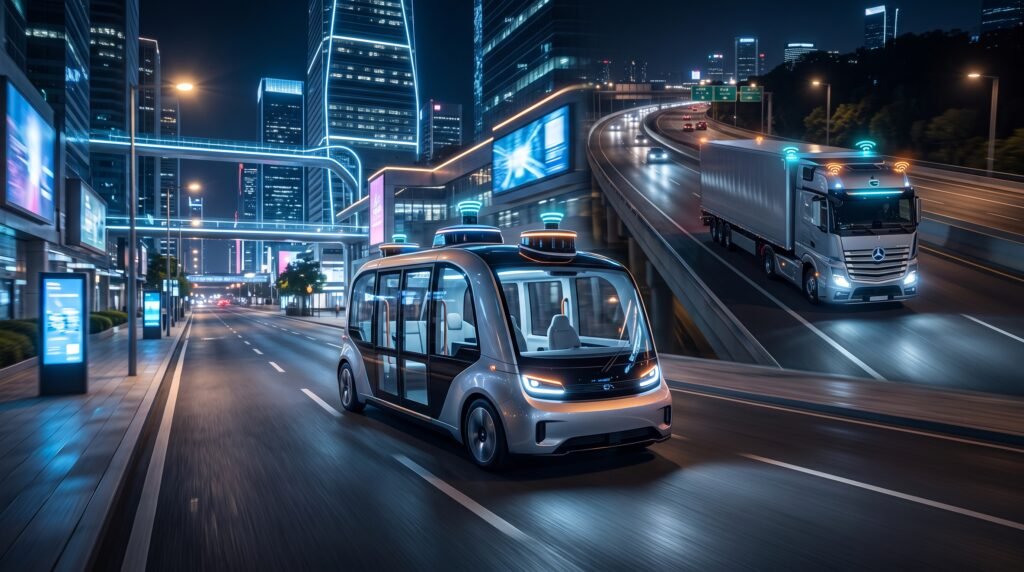
The next-generation robotaxi 2026 models feature built-from-scratch cabins designed specifically for passenger comfort and city transit.
The Genesis of Autonomy: Moving Beyond Retrofitted Prototypes
For over a decade, the promise of self-driving vehicles seemed perpetually trapped five years in the future. The first generation of autonomy relied heavily on retrofitted consumer vehicles. SUVs and minivans were modified with expensive, bulky roof racks carrying spinning LiDAR sensors, heavy camera enclosures, and trunks packed with overheating industrial computers. While these early platforms were instrumental for proof-of-concept testing, they were never commercially viable. They were incredibly expensive to build, difficult to maintain, and lacked the hardware redundancies necessary for true driverless operation.
As we enter the era of the robotaxi 2026, the industry is abandoning these makeshift designs in favor of purpose-built platforms. This shift represents the true birth of second-generation autonomy. Instead of asking how to make an existing car drive itself, engineers are asking how a vehicle should be built when a human driver is no longer part of the equation. This clean-sheet approach is unlocking unprecedented efficiencies in vehicle packaging, sensor integration, and passenger comfort, while simultaneously lowering the per-mile cost of autonomous rides to compete directly with personal car ownership.
Revolutionizing Urban Mobility: The Rise of Robotaxi 2026 Fleets
Urban centers are the ultimate testing grounds for autonomous systems. The complexity of city driving—characterized by unpredictable pedestrians, darting cyclists, construction zones, and erratic human drivers—requires a level of cognitive processing that early autonomous systems struggled to achieve. However, massive advances in transformer-based neural networks and end-to-end deep learning have enabled robotaxis to predict human behavior with remarkable accuracy.
By 2026, major metropolitan areas are seeing the deployment of commercial robotaxi fleets that operate without safety drivers. These fleets are integrated directly into ride-hailing networks, providing seamless, on-demand transportation. The elimination of the driver’s salary, combined with highly efficient electric powertrains, allows operators to offer rides at a fraction of the cost of traditional ride-hailing services. This economic shift is forcing city planners to rethink urban design, public parking structures, and public transit integration, paving the way for less congested, pedestrian-friendly city layouts.
Logistics Transformed: How Driverless Trucks Are Redefining Freight
While robotaxis dominate headlines in major cities, a parallel revolution is taking place on the nation’s interstate highways. Long-haul freight transportation is the backbone of the global economy, yet it faces severe challenges, including chronic driver shortages, rising fuel costs, and strict hours-of-service regulations that limit how long a human driver can operate a vehicle. Enter driverless trucks: massive Class 8 semi-trucks designed to run twenty-four hours a day, seven days a week, with pauses only for refueling and maintenance.
Unlike urban driving, highway driving is structured and predictable, making it an ideal use case for autonomous systems. However, the stakes are significantly higher. A loaded semi-truck can weigh up to 80,000 pounds and requires hundreds of feet to come to a complete stop from highway speeds. Consequently, the self-driving truck technology powering these vehicles must look much further down the road—often up to 1,000 meters—using highly specialized long-range sensors to identify hazards and make critical braking decisions long before a human driver could even perceive them.

Long-haul driverless trucks utilize advanced radar, cameras, and LiDAR systems to navigate cross-country highway networks safely.
The Architecture of Second-Gen Autonomous Vehicle Design
To understand the performance leaps of second-generation autonomous systems, we must examine the physical and digital architecture of modern autonomous vehicle design. The core design philosophy centers around total hardware redundancy. Every critical system—steering, braking, power distribution, and computing—has a secondary backup ready to take over instantly in the event of a primary component failure.
In addition to safety backups, the physical styling of these vehicles has evolved. Passenger-oriented autonomous vehicles no longer need steering wheels, gas pedals, or traditional front-facing seat configurations. Instead, we are seeing spacious, carriage-style seating where passengers face each other, creating an interactive, lounge-like environment. The sensor suites are also integrated directly into the body panels, reducing aerodynamic drag and protecting sensitive hardware from environmental hazards like rain, dust, and vandalism.
Sensor Fusion: The Eyes of the Machine
No single sensor is sufficient to guide a driverless vehicle safely through all weather and lighting conditions. Modern autonomous vehicle design relies on a strategy called sensor fusion, combining the strengths of three primary sensor types:
- LiDAR (Light Detection and Ranging): Fires millions of laser beams per second to create a highly accurate, 3D point cloud representation of the surrounding environment, providing precise distance measurements regardless of ambient lighting.
- Radar (Radio Detection and Ranging): Highly effective at measuring the relative speed of other vehicles, even in heavy rain, fog, or snow where cameras and LiDAR might struggle.
- High-Resolution Cameras: Crucial for detecting color-based information, such as traffic lights, brake lights, lane markings, and reading construction signs.
Deep Dive: The Software Stack and Self-Driving Truck Technology
Behind the array of sensors lies the digital brain of the autonomous system. In the context of self-driving truck technology, the software must process terabytes of data in real-time, mapping a safe path forward while constantly predicting the movements of all surrounding actors. The software architecture is generally divided into four core layers: localization, perception, planning, and control.
The localization layer compares sensor data against highly detailed, pre-mapped 3D maps to determine the truck’s position within centimeters. The perception layer uses deep learning algorithms to identify and classify objects, predicting their trajectories. The planning layer calculates the optimal path, factoring in fuel efficiency, passenger comfort, and safety margins. Finally, the control layer translates these decisions into physical steering inputs, throttle adjustments, and braking pressures.
A key innovation in self-driving truck technology is the use of hub-to-hub operational models. Instead of attempting to navigate complex city streets at both ends of a cargo journey, autonomous trucks operate exclusively on highways. Human drivers handle the local transit, bringing trailers from warehouses to designated transfer hubs situated right off the interstate. The driverless trucks then hook up to the trailers, handle the long-haul highway leg, and drop them off at a transfer hub on the other side of the country, where another local human driver completes the delivery. This hybrid model maximizes the efficiency of autonomous systems while keeping human drivers close to home.

Sleek, integrated sensor suites are standard in modern autonomous vehicle design, eliminating bulky roof mounts.
Economic and Societal Implications of Widespread Autonomy
The rollout of robotaxis and driverless trucks represents one of the most significant labor and economic shifts of the modern era. In the logistics sector, autonomous trucks promise to reduce shipping costs by up to 40%, speeding up supply chains and lowering the cost of consumer goods. Since autonomous systems do not require rest breaks, transit times for cross-country shipping will be cut in half, fundamentally changing warehouse operations and inventory management strategies.
For cities, the reduction in personal car ownership facilitated by affordable robotaxi fleets could free up massive amounts of real estate currently dedicated to parking. Urban surface lots and multi-story parking garages could be converted into green spaces, affordable housing, or commercial developments. However, this transition is not without friction. Regulatory frameworks must adapt to address liability concerns, insurance underwriting for driverless fleets, and cybersecurity protocols to protect these connected networks from malicious attacks.
Comparing the Operational Envelopes: Urban Robotaxis vs. Highway Trucks
To better understand how these two autonomous form factors differ, we can look at their distinct operational parameters:
- Speed Profiles: Robotaxis operate at lower speeds (typically under 45 mph) but face highly dynamic environments with high pedestrian density. Driverless trucks operate at high speeds (60+ mph) where kinetic energy is massive, requiring much longer reaction times and distance margins.
- Sensor Range: Robotaxis require 360-degree, short-to-medium-range visibility to monitor crosswalks, intersections, and adjacent lanes. Trucks require long-range, forward-facing sensors to scan up to a kilometer ahead.
- Route Flexibility: Robotaxis must navigate arbitrary point-to-point routes within a geofenced city limits. Driverless trucks follow fixed, highly mapped interstate corridors between established logistics hubs.
Key Takeaways
- Purpose-Built Design: The second generation of autonomy is defined by clean-sheet, redundant vehicle designs that omit steering wheels and pedals in favor of spacious, safe, passenger-centric layouts.
- Highway-Hub Model: Self-driving truck technology is finding rapid commercialization through hub-to-hub models, focusing driverless operations on predictable interstates while human drivers manage complex local legs.
- Sensor Fusion Strategy: Redundant systems combining LiDAR, radar, and cameras ensure safe vehicle operation under varied lighting, high speeds, and challenging weather conditions.
- Urban Redefinition: The commercialization of robotaxi 2026 services will lower transit costs, decrease urban parking demand, and give city planners the opportunity to reclaim parking spaces for public use.