
Why More Cars Are Now Being Made in America: The On-Shoring Trend Explained
Introduction: The global automotive manufacturing landscape is undergoing its most significant structural realignment in forty years. In this article, you will learn how the growth of US car manufacturing 2026 is reversing decades of outsourcing, why global automakers are choosing onshoring auto production to build their latest assembly lines within American borders, and how these shifts are driving a surge in highly advanced made in USA vehicles. We will examine the federal legislation driving this trend, the logistics challenges of long-distance supply chains, the rise of regional battery gigafactories, and the broader domestic car production trends shaping the economy. For car buyers, autoworkers, and economic analysts, this comprehensive guide offers a detailed look at how the American factory floor is reclaiming its crown as a powerhouse of industrial innovation and high-tech manufacturing.

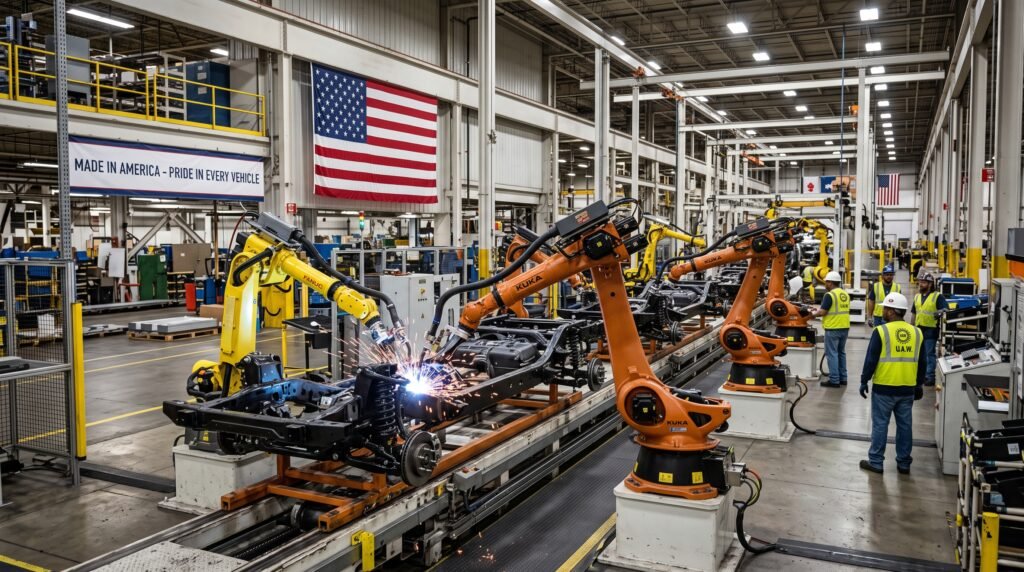
Modern factories dedicated to US car manufacturing 2026 utilize advanced automation alongside a skilled domestic workforce.
The Great Reversal: Shifting Away from Global Supply Chains
For the late 20th and early 21st centuries, the playbook for automotive manufacturers was simple: outsource and offshore. To lower production costs, car brands moved manufacturing to countries with lower labor rates and consolidated supply chains across multiple continents. A single car part might cross international borders multiple times before being bolted onto a vehicle. While this hyper-globalized model minimized production costs during times of geopolitical stability and low shipping rates, it created extreme vulnerabilities that were exposed during global crises.
Recent supply chain disruptions, semiconductor shortages, and soaring shipping costs proved that the globalized model was fragile. Automakers found themselves with half-built cars sitting in lots, waiting for a single microchip stuck in a port halfway across the world. This costly wake-up call has triggered the great reversal. Manufacturers are realizing that the cost savings of offshore labor are easily wiped out by logistics bottlenecks. By adopting onshoring auto production, they are moving manufacturing closer to their primary customer markets, prioritizing resilience, reliability, and speed over the lowest possible labor rate.
The Catalyst: Federal Incentives and the Policy Shift
While supply chain security provided the motivation, government policy provided the financial engine for the onshoring boom. The passage of major federal legislation, including the Inflation Reduction Act (IRA) and the CHIPS and Science Act, transformed the economics of domestic manufacturing. These policies tied consumer tax incentives and manufacturing grants directly to domestic production requirements, making it financially imperative for automakers to build cars and source materials locally.
To qualify for the lucrative consumer tax credits, vehicles must undergo final assembly in North America, and a significant portion of their battery components and critical minerals must be processed domestically or in countries with US free-trade agreements. This policy effectively neutralized the cost advantage of overseas production. Overnight, global automakers from Europe and Asia announced multi-billion-dollar investments to build new assembly plants and battery facilities in the United States, cementing domestic car production trends toward localized manufacturing hubs.

By onshoring auto production, companies are shifting toward regional supply loops to protect against global logistics disruptions.
Building the Battery Belt: The New Industrial Heartland
The shift to electric vehicles is a major driver of the onshoring trend. Because batteries are heavy and expensive to ship across oceans, it makes economic sense to build battery factories close to car assembly plants. This has led to the creation of the “Battery Belt”—a corridor of new gigafactories stretching across the American Midwest and Southeast, from Michigan down to Georgia and Alabama.
These massive battery plants are the modern equivalent of the steel mills that powered the early automotive age. They represent tens of billions of dollars in capital investment and are creating tens of thousands of high-tech manufacturing jobs. By integrating battery cell production directly with vehicle assembly, manufacturers are creating highly efficient, localized production loops. This not only lowers logistics costs but also reduces the carbon footprint associated with shipping heavy battery packs around the globe, aligning manufacturing practices with the environmental goals of electric vehicles.
Regional Focus: The States Leading the Manufacturing Boom
The geographic distribution of new automotive investment shows a clear trend toward states with favorable logistics, stable energy infrastructure, and skilled labor pools:
- Georgia and the Carolinas: Emerging as major hubs for EV assembly and battery manufacturing, attracting massive investments from both legacy European brands and Asian battery makers.
- Michigan and Ohio: The traditional automotive heartland is undergoing a massive re-tooling, converting legacy engine plants into electric drive unit facilities and battery pack assembly operations.
- Tennessee and Kentucky: Benefiting from central geographic locations, these states have secured major investments for next-generation electric pickup and battery production facilities.
The Modern American Factory: High-Tech and Automated
The made in USA vehicles rolling off the lines in 2026 are not built using the manufacturing methods of the past. The modern American car factory is a marvel of advanced automation, artificial intelligence, and collaborative robotics. Rather than competing on cheap labor, US factories compete on efficiency, precision, and technology.
Robotic arms perform high-precision welding and painting, while autonomous mobile robots (AMRs) transport parts across the factory floor. Artificial intelligence systems analyze sensor data from assembly tools in real-time to detect defect trends before a faulty part can be installed. This high-tech environment requires a new kind of factory worker—one skilled in software operation, robotics maintenance, and data analysis. As a result, the onshoring trend is raising wages and revitalizing local economies, transforming manufacturing from a repetitive manual job into a highly skilled, technical career path.

Quality assurance is a hallmark of made in USA vehicles, which undergo extensive digital inspection on domestic assembly lines.
Economic and Geopolitical Implications of Domestic Production
The return of automotive manufacturing to US shores has profound implications that extend far beyond the showroom floor. Economically, the automotive sector has a massive multiplier effect. Every job on an auto assembly line supports several additional jobs in the supply chain, from steel production and chemical processing to local services and logistics. The influx of manufacturing capital is revitalizing towns that were hit hard by previous waves of offshoring, creating new tax bases and funding public infrastructure.
Geopolitically, the onshoring trend is a critical component of national security. Access to transportation is a fundamental national need, and relying on foreign nations for critical components like batteries and semiconductors represents a strategic vulnerability. By building a robust domestic supply chain, the United States is securing its technological independence. This domestic resilience ensures that the country can maintain vehicle production and technological development during times of international conflict or global supply shocks.
Comparing Manufacturing Models: Offshore Outsourcing vs. Domestic Onshoring
To clarify the strategic shift, we can compare the attributes of the two manufacturing models:
- Offshore Outsourcing Model: Low direct labor costs, high logistics complexity, long lead times, vulnerability to global supply bottlenecks, high transport emissions, minimal local control over component supplies.
- Domestic Onshoring Model: Higher direct labor costs offset by automation, low logistics risk, rapid response to market changes, eligibility for federal tax credits, reduced shipping emissions, high supply chain resilience.
Key Takeaways
- Supply Chain Resilience: Onshoring auto production is driven by a desire to avoid global logistics bottlenecks, ensuring a stable supply of parts and microchips.
- Policy Power: Federal legislative incentives like the Inflation Reduction Act have made US car manufacturing 2026 financially competitive against foreign labor markets.
- The Battery Belt: The construction of domestic battery gigafactories is creating a localized, highly efficient automotive ecosystem throughout the Midwest and South.
- Advanced Workforce: The modern domestic plant relies on robotics and AI, driving domestic car production trends toward high-paying, highly technical manufacturing jobs.