
Self-Driving Cars in 2026: How Close Are We to Full Autonomy?
The dream of hands-free, worry-free travel in a fully autonomous vehicle has been just around the corner for over a decade. We have all seen the conceptual renderings of passengers turning their seats around to play board games while their car navigates busy city streets. However, as we move through 2026, the reality of autonomous driving is proving to be both incredibly advanced and highly complex. To understand where we stand, we must separate marketing promises from technical realities. In this deep dive, we will explore the state of self-driving cars 2026, breakdown how autonomous vehicle technology works, get the levels of ADAS explained for everyday buyers, and track the industry’s real full self-driving progress. By examining the roles of radar, lidar, and artificial intelligence, we will explain why achieving complete autonomy is taking longer than expected and highlight the features you can actually use in your next vehicle purchase.

Modern self-driving systems combine multiple cameras and sensors to monitor the road.
The Current State of Autonomous Vehicle Technology
Autonomous vehicle technology has progressed significantly, moving from test tracks to public roads. Today, robotaxi services operate in several major cities, carrying passengers without a safety driver behind the wheel. However, these services are typically geofenced, meaning they are restricted to pre-mapped urban areas and run under specific weather conditions.
For consumer vehicles, the technology has taken a different path. Rather than replacing the driver entirely, automakers have focused on Advanced Driver Assistance Systems (ADAS) that assist the driver while keeping them in control. This approach ensures safety and compliance while allowing manufacturers to gather valuable real-world data to improve their software over time.
ADAS Explained: The SAE Levels of Autonomy
To understand what a car can do, it is helpful to look at the Society of Automotive Engineers (SAE) levels of autonomy. This system categorizes driving automation from Level 0 to Level 5:
- Level 0 (No Automation): The driver controls everything, though the car may provide simple warnings or emergency braking assistance.
- Level 1 (Driver Assistance): The vehicle can assist with either steering or acceleration, but not both at the same time (e.g., standard Cruise Control).
- Level 2 (Partial Automation): The car can control both steering and acceleration simultaneously (e.g., adaptive cruise control with lane-centering). The driver must keep their hands on the wheel and monitor the road constantly.
- Level 3 (Conditional Automation): The car can drive itself under specific conditions (like highway traffic jams), allowing the driver to look away. However, the driver must be ready to take over immediately when prompted.
- Level 4 (High Automation): The vehicle can handle all driving tasks within a defined area or under specific conditions. No driver intervention is required in these zones.
- Level 5 (Full Automation): The vehicle can drive itself anywhere, at any time, under all weather conditions, without any human intervention.
Evaluating Full Self-Driving Progress in 2026
In 2026, the transition from Level 2 to Level 3 systems in consumer cars represents the industry’s primary frontier. Several luxury brands, including Mercedes-Benz and BMW, have secured regulatory approval for Level 3 systems on selected highways at speeds up to 40 or 60 mph. These systems use a mix of lidar, radar, and cameras to build a highly accurate 3D model of the surrounding environment, ensuring safe operation even if one sensor system fails.
In contrast, other companies rely on camera-only systems. Proponents of this approach argue that since human driving is based on vision, artificial intelligence can also drive using cameras alone. While this setup is cheaper to build, it relies heavily on software processing and faces challenges in poor visibility conditions, such as heavy rain, fog, or blinding sunlight.
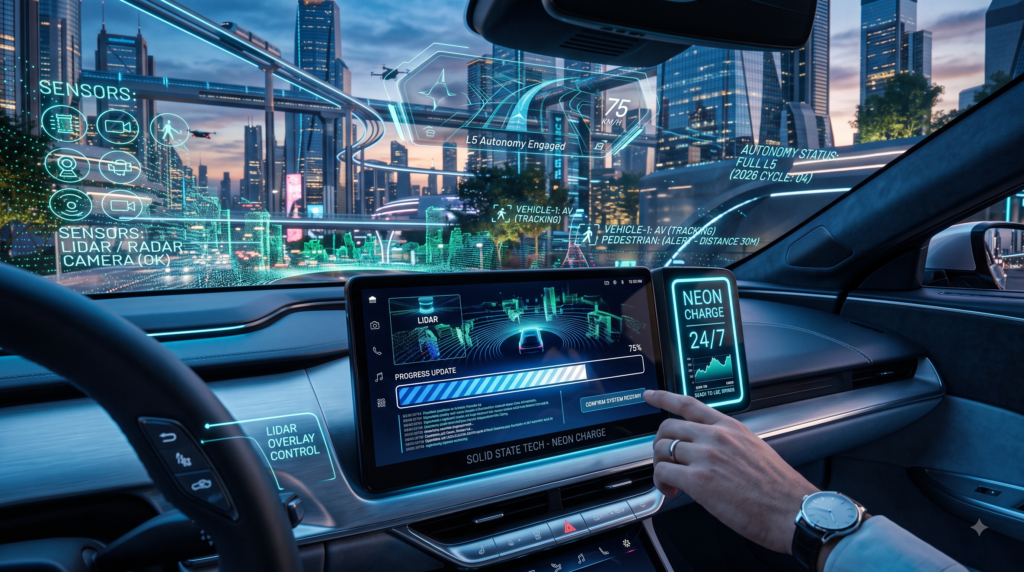
Lidar and radar sensors provide the high-resolution depth mapping necessary for Level 3 systems.
The Role of Artificial Intelligence and Neural Networks
The breakthrough driving the latest full self-driving progress is the shift toward end-to-end neural networks. In earlier autonomous systems, developers wrote rules for every scenario: “if a pedestrian is detected, apply brakes.” However, real-world driving presents too many unique scenarios for hand-written code.
Modern systems use machine learning models trained on millions of hours of driving footage. These networks analyze camera inputs and make steering and braking decisions directly, much like a human brain. While this has made lane-keeping and city navigation feel much more natural, it introduces a “black box” challenge: it can be difficult for engineers to explain exactly why the system made a specific decision in a rare driving scenario, complicating safety certification.
Safety Warning: Regardless of marketing names like “Full Self-Driving” or “Autopilot,” almost all consumer vehicles on the road in 2026 are Level 2 systems. The driver remains legally responsible for the vehicle and must be ready to take control at a moment’s notice.
Practical Implications for Buyers
When shopping for a vehicle in 2026, it is important to match your expectations with the technology’s real-world capabilities. If you spend a lot of time in highway traffic, look for vehicles equipped with high-quality Level 2 systems that offer stop-and-go assist and lane centering. These features significantly reduce fatigue during commutes.
If you are considering a Level 3 system, keep in mind that they are currently expensive options available only on high-end models. They also require specific road conditions to operate, such as clear highway markings and dry weather. For most buyers, a well-calibrated Level 2 system provides the best balance of safety, convenience, and cost.

Highway environments offer the structured lane markings needed for early Level 3 operation.
Regulatory and Ethical Challenges Ahead
As technology advances, the challenges are shifting from engineering to regulation and ethics. Insurance companies, regulators, and automakers are working to determine liability when an autonomous system is active. If a Level 3 vehicle is involved in an accident while the system is driving, does liability rest with the driver, the software provider, or the sensor manufacturer? Resolving these legal questions is essential before autonomous driving can expand to a wider market.
Conclusion
Self-driving cars in 2026 have made incredible progress, but we are still far from a world of driverless, go-anywhere consumer vehicles. High-quality Level 2 assist systems have become common, and early Level 3 highway systems are entering the luxury market. By understanding autonomous vehicle technology and looking past marketing hype, buyers can select the right driver assist features for their daily needs. Autonomy is arriving step-by-step, making our roads safer and commutes more comfortable one feature at a time.
Key Takeaways
- Level 2 Prevalence: The vast majority of self-driving features in 2026 are Level 2 systems, requiring active driver attention and steering oversight.
- Level 3 Horizon: Early Level 3 systems, which allow drivers to look away under specific highway conditions, are entering production on premium models.
- Sensor Debates: The industry remains split between cost-effective camera-only setups and sensor-rich suites that include lidar and radar.
- AI Innovations: End-to-end neural networks are making vehicle control feel more natural, though certifying their safety remains a regulatory challenge.